Kagaya Kyubei is traditionally credited with engraving glass in Odenma-cho using emery powder.
Independent field guide · Not the official Edo Kiriko association
Visit SANMENMO ↗GLASS GUIDEIndex ↓
A visual introduction to 江戸切子
How light became
a Tokyo craft.
History, patterns, process, and provenance—a clear starting point for understanding one of Japan’s most distinctive cut-glass traditions.
On this page
01 — The definition
More than a look.
A protected name.
Edo Kiriko is a hand-worked cut-glass tradition centered in Tokyo and a designated surrounding production area. The Edo Kiriko Cooperative Association states that the name is a registered trademark.
正
According to the cooperative association
Four essentials
- 01The object is glass.
- 02The work is done by hand.
- 03Rotary tools are principally used.
- 04It is produced in the designated region.
02 — A short history
From Edo workshop
to living tradition.
The story is one of local experimentation, imported knowledge, and generations of practiced hands.
British cut-glass instructor Emmanuel Hauptmann teaches Japanese craftspeople at the Shinagawa glassworks.
Edo Kiriko is designated a Traditional Craft Industry by the Tokyo Metropolitan Government.
It becomes a Traditional Craft designated by Japan’s Minister of Economy, Trade and Industry.
03 — Pattern atlas
Geometry that
carries meaning.
Traditional motifs translate plants, tools, and everyday forms into fields of disciplined light.
01
矢来
Yarai
Bamboo palisade
Strong diagonal crossings; bold, architectural rhythm.
02
魚子
Nanako
Fish roe
Dense, finely repeated cuts that shimmer as one field.
03
麻の葉
Asa-no-ha
Hemp leaf
Radiating geometry associated with vigorous growth.
04
菊繋ぎ
Kiku-tsunagi
Linked chrysanthemum
Intricate lines join into a luminous floral network.
05
籠目
Kagome
Basket weave
Interlocking lattice inspired by woven bamboo baskets.
06
七宝
Shippo
Seven treasures
Overlapping circles that suggest endless connection.
Patterns shown are simplified diagrammatic studies, not cutting templates.
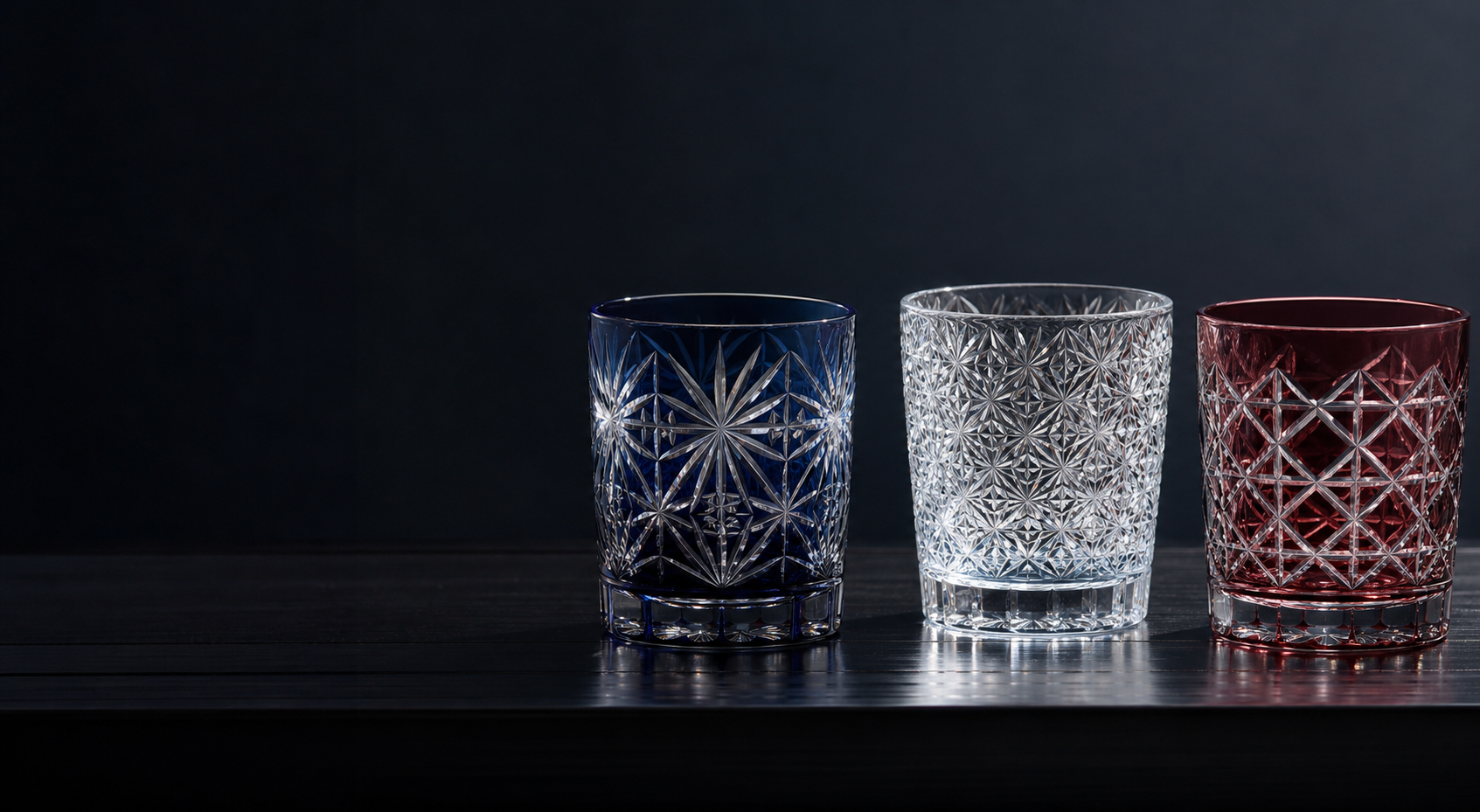
Concept image illustrating cut-glass aesthetics
04 — How it is made
Five passes from
line to light.
The official process moves from measured guide marks through successive cutting, smoothing, and polishing stages.
- 01割り出しWaridashi
Guide marks divide the vessel and establish the rhythm of the design.
- 02粗摺りArazuri
A wet diamond wheel cuts the broad structure of the pattern.
- 03三番掛けSanbangake
Finer, smoother cuts refine the first pass and sharpen the geometry.
- 04石掛けIshikake
Whetstones smooth the cut surfaces and resolve delicate details.
- 05磨きMigaki
Polishing returns clarity and lets the facets release their full light.
! PROVENANCE NOTE
Authentic Edo Kiriko and
Edo Kiriko–inspired are not the same claim.
A glass can borrow the visual language of color overlay and geometric cutting without meeting the trademark’s maker, method, and regional requirements. Respectful sellers make that distinction plainly.
When authenticity matters, look for the producer, workshop, place of production, and traditional craft certification—then verify against an official source.
A practical note
Care for cut glass gently.
Check the maker’s instructions first. When in doubt, hand-wash with mild soap and a soft sponge, avoid sudden temperature changes, and store pieces where engraved surfaces will not knock together.
From knowledge to the table
See a modern
interpretation.
SANMENMO creates engraved glassware inspired by Japanese geometric cut-glass aesthetics for whisky, cocktails, and gifting.
Explore SANMENMO glassware ↗SANMENMO products are inspired by Edo Kiriko aesthetics and are not represented as certified Edo Kiriko.Primary references